
Sometimes I am somewhere - don't worry, this blog entry will eventually make a concrete point - sometimes I am somewhere and I feel the urge to transform my experience into a drawing, a painting, a poem, a short story, a piece of music. Often some of them at the same time - "Oh, I wish I could make a painting of this beautiful mountain view; or write a poem about it; and wouldn't it be great to have a song about it"?"
Of course, most of the time the mountain view simply stays a mountain view. At best, it becomes a memory to pop out at some undefined moment in the future, for example, when you suddenly smell something that reminds you of the smell of that same old mountain view back then - yes, even mountain views are entitled to an olfactory element.
Hence my admiration for people who dó transform the mountain view into a song, or an art work, or a poem. Or in all of them at the same time, as Sido Martens did recently in his recent project "Wankelmoed” (please come up with suggestions for translation in English - "wankelmoedig" means hesitant or wavering, "wankelmoed" literally means "hesitant courage"). Wankelmoed is a project which led to a CD with songs written by Sido (words and music), sung and played by Sido, packed in a small square book containing pictures by Sido of the landscapes and places that inspired him to write the songs (which were recorded by Sido on the locations he sings about, in a camper van owned by Sido), as well as verbal reflections on the landscapes and places expressed in poetic prose by Sido.
I am not going to write a review here of the complete package. Taste is, as you know by now, a personal matter; and judgments about 'quality' are for many listeners completely redundant, and rightly so. Suffice it to say I like the CD - I like Sido's voice which does remind me of the voice of Fred Piek (Sido as well as Piek played in the legendary Dutch folk-rock group Fungus - the Lowlands' equivalent of Steeleye Span), I like his guitar (and mandolin, and banjo) playing, I like the fact that the song lyrics are descriptive rather than metaphorical, and I like the concept of the project - the inspiration by landscapes and places, the recording on location, the do-it-yourself-mentality up to the selling of the CD. Musical self-sufficiency (speaking of which: check out Sido's “concert camper van”, which furnished a concert space for audiences up to ten people, as Sido proclaimed "dependent on size and density" of the individual audience members). That's all you'll get from me, as a review.
What I would like to point out here is that actually what Sido has been making is an LP rather than a CD.
This deserves some explanation. Long ago, in times animals still could speak, there were no CDs but LPs: big black disks,playable on both sides, containing five or six songs on each side. Now the technical matters are not very interesting; what is interesting is that LPs are things loaded with nostalgia for the people I interview for research purposes. They are, in that respect, much 'thingier' than CDs.
There is a sort of pecking order of musical thinginess in which LPs (together with Stradivarius' fiddles) stand highest in rank and cassette tapes (together with Yamaha's orange plastic recorders) lowest. Cassette tapes as well as plastic recorders are easily thrown away. LPs, however, have the tendency to stick around in households long after the record player has disappeared. "We can't throw them away", my interviewees tell me. "Once the record player will be repaired, we will play the LPs again". Or: "I keep them as reference material, to look up who sung which song again, back in 1979".
But the thinginess of music seems to come to an end. We now live in the era of the MP3-file. We have freed the information, which was packed in the grooves of the LP and is now contained in the 1s and 0s of the MP3 file, of its carriers. Which music needs a carrier when it can be transported through the air, thanks to the wireless networks zooming around our poor heads? We don't own music anymore - at best we own an MP3-carrier; for example a USB-stick in the form of a music cassette - very fitting, I must say:
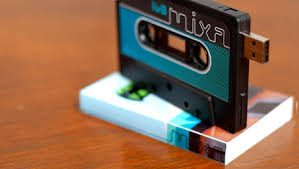
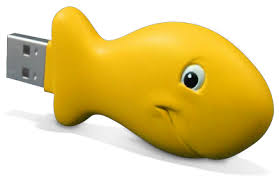
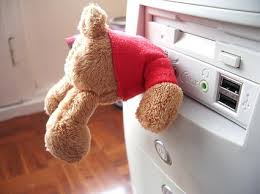
Are there USB-sticks yet in the form of LPs? I don't think so... And for the newest listener, the carrier is already completely out of sight, and the MP3-files are not in his possession but are only there to be played "just-in-time", thanks to services such as Spotify. Which also leads to the nice effect that people using a USB-stick-in-cassette-form to poke fun at history and people like me who still know what a cassette actually was are being poked fun at in turn by the newest listener - he laughs disdainful about anyone using an USB-stick in whatever form: cassette, fish, bear - ridiculously outdated, all of them.
Which is great, actually - because music is never 'just music', it includes all the more-or-less musicky things going on together with the sound - the thoughts, the words, the sights, the images, the people, the tastes, the smells, the memories, the love, the anger, everything. And if that is the case, if music is never 'just music', why then should a CD be 'just music'?
Well done, Sido!

Hence my admiration for people who dó transform the mountain view into a song, or an art work, or a poem. Or in all of them at the same time, as Sido Martens did recently in his recent project "Wankelmoed” (please come up with suggestions for translation in English - "wankelmoedig" means hesitant or wavering, "wankelmoed" literally means "hesitant courage"). Wankelmoed is a project which led to a CD with songs written by Sido (words and music), sung and played by Sido, packed in a small square book containing pictures by Sido of the landscapes and places that inspired him to write the songs (which were recorded by Sido on the locations he sings about, in a camper van owned by Sido), as well as verbal reflections on the landscapes and places expressed in poetic prose by Sido.
I am not going to write a review here of the complete package. Taste is, as you know by now, a personal matter; and judgments about 'quality' are for many listeners completely redundant, and rightly so. Suffice it to say I like the CD - I like Sido's voice which does remind me of the voice of Fred Piek (Sido as well as Piek played in the legendary Dutch folk-rock group Fungus - the Lowlands' equivalent of Steeleye Span), I like his guitar (and mandolin, and banjo) playing, I like the fact that the song lyrics are descriptive rather than metaphorical, and I like the concept of the project - the inspiration by landscapes and places, the recording on location, the do-it-yourself-mentality up to the selling of the CD. Musical self-sufficiency (speaking of which: check out Sido's “concert camper van”, which furnished a concert space for audiences up to ten people, as Sido proclaimed "dependent on size and density" of the individual audience members). That's all you'll get from me, as a review.
What I would like to point out here is that actually what Sido has been making is an LP rather than a CD.
This deserves some explanation. Long ago, in times animals still could speak, there were no CDs but LPs: big black disks,playable on both sides, containing five or six songs on each side. Now the technical matters are not very interesting; what is interesting is that LPs are things loaded with nostalgia for the people I interview for research purposes. They are, in that respect, much 'thingier' than CDs.
There is a sort of pecking order of musical thinginess in which LPs (together with Stradivarius' fiddles) stand highest in rank and cassette tapes (together with Yamaha's orange plastic recorders) lowest. Cassette tapes as well as plastic recorders are easily thrown away. LPs, however, have the tendency to stick around in households long after the record player has disappeared. "We can't throw them away", my interviewees tell me. "Once the record player will be repaired, we will play the LPs again". Or: "I keep them as reference material, to look up who sung which song again, back in 1979".
But the thinginess of music seems to come to an end. We now live in the era of the MP3-file. We have freed the information, which was packed in the grooves of the LP and is now contained in the 1s and 0s of the MP3 file, of its carriers. Which music needs a carrier when it can be transported through the air, thanks to the wireless networks zooming around our poor heads? We don't own music anymore - at best we own an MP3-carrier; for example a USB-stick in the form of a music cassette - very fitting, I must say:
Are there USB-sticks yet in the form of LPs? I don't think so... And for the newest listener, the carrier is already completely out of sight, and the MP3-files are not in his possession but are only there to be played "just-in-time", thanks to services such as Spotify. Which also leads to the nice effect that people using a USB-stick-in-cassette-form to poke fun at history and people like me who still know what a cassette actually was are being poked fun at in turn by the newest listener - he laughs disdainful about anyone using an USB-stick in whatever form: cassette, fish, bear - ridiculously outdated, all of them.
Which is great, actually - because music is never 'just music', it includes all the more-or-less musicky things going on together with the sound - the thoughts, the words, the sights, the images, the people, the tastes, the smells, the memories, the love, the anger, everything. And if that is the case, if music is never 'just music', why then should a CD be 'just music'?
Well done, Sido!

